
May 22, 1986. Steven Bryant, known within ISKCON as Sulocana das, was living out of his van on a Los Angeles street. He had been tracked across the country for weeks. He knew it. He kept moving anyway, because he had decided that what he knew mattered more than what happened to him.
What he knew was this: the New Vrindaban community in West Virginia had become a criminal operation. Children were being sexually abused in the community school. Drugs were being manufactured and sold. At least one man had already been murdered and buried in a pre-dug grave on the property. Bryant had published his allegations, named names, and contacted law enforcement. He had made himself into the one thing a closed community cannot tolerate: a witness who will not stop talking.
That evening, Thomas Drescher approached the van and fired two bullets into Bryant’s head.
Drescher, known as Tirtha das, later testified that he felt “duty bound” to carry out the killing. The leadership had instructed him to perform “the needful.” It was sanctioned from above, funded by the community, and understood by those who knew as a necessary act of institutional survival. Drescher was not possessed by a demon. He was possessed by something worse: an ideology. One that still operates within ISKCON today.
A Story Already Written
Over a century earlier, Fyodor Dostoevsky had already written this scene.
His 1872 novel Demons was a direct response to a real murder: the killing of a Russian student, Ivan Ivanov, by a revolutionary cell whose leader decided that a member who wanted to leave had to die instead. Dostoevsky built the novel around the mechanics of how that killing was organized, justified, and used to bind the surviving members together through shared guilt. The parallels to New Vrindaban are not approximate. They are precise. A sincere community. A manipulative leader. A dissenter who sees too clearly. A murder committed not despite the group’s beliefs but because of them.
This is the architecture of ideological possession. It did not end with Dostoevsky’s fictional revolutionaries. It did not end with the New Vrindaban convictions. It operates today, in subtler forms, every time an institution decides that its image matters more than the truth.
The Architecture
In Demons, the revolutionary leader Verkhovensky is not a true believer. He cares about power. His method is to arrange the murder of a defector so that every member of his cell becomes a co-conspirator. Once you have participated in the killing, even by silence, the ideology owns you completely.
Kirtanananda Swami ran New Vrindaban on the same logic. After Prabhupada’s death in 1977, he declared himself the exclusive spiritual authority of his zone and transformed a devotional community into a fiefdom. He controlled finances, marriages, and the spiritual “standing” of every devotee. When his authority was challenged, he did not act directly. He instructed subordinates to handle it. “The needful.”
In Dostoevsky’s novel, the victim is Ivan Shatov, a former member of the cell who turned away from nihilism and toward faith. He wants to leave quietly. He wants to start over. The cell lures him to a remote spot and kills him. In New Vrindaban, the victim is Bryant, a devotee who opened his eyes to the abuse around him and would not be quiet. The group labeled him a blasphemer. A “demon.” It was the possessed who called the free man a demon.
The pattern is identical: the enemy is never the outsider. Outsiders can be dismissed. The enemy is the insider who walks away and starts talking. The insider knows the secrets. The insider has credibility. The insider can name the bodies.
Bullets are no longer necessary. The same architecture now operates through silence, social destruction, and institutional machinery. But the logic is unchanged.
When Everything Is Permitted
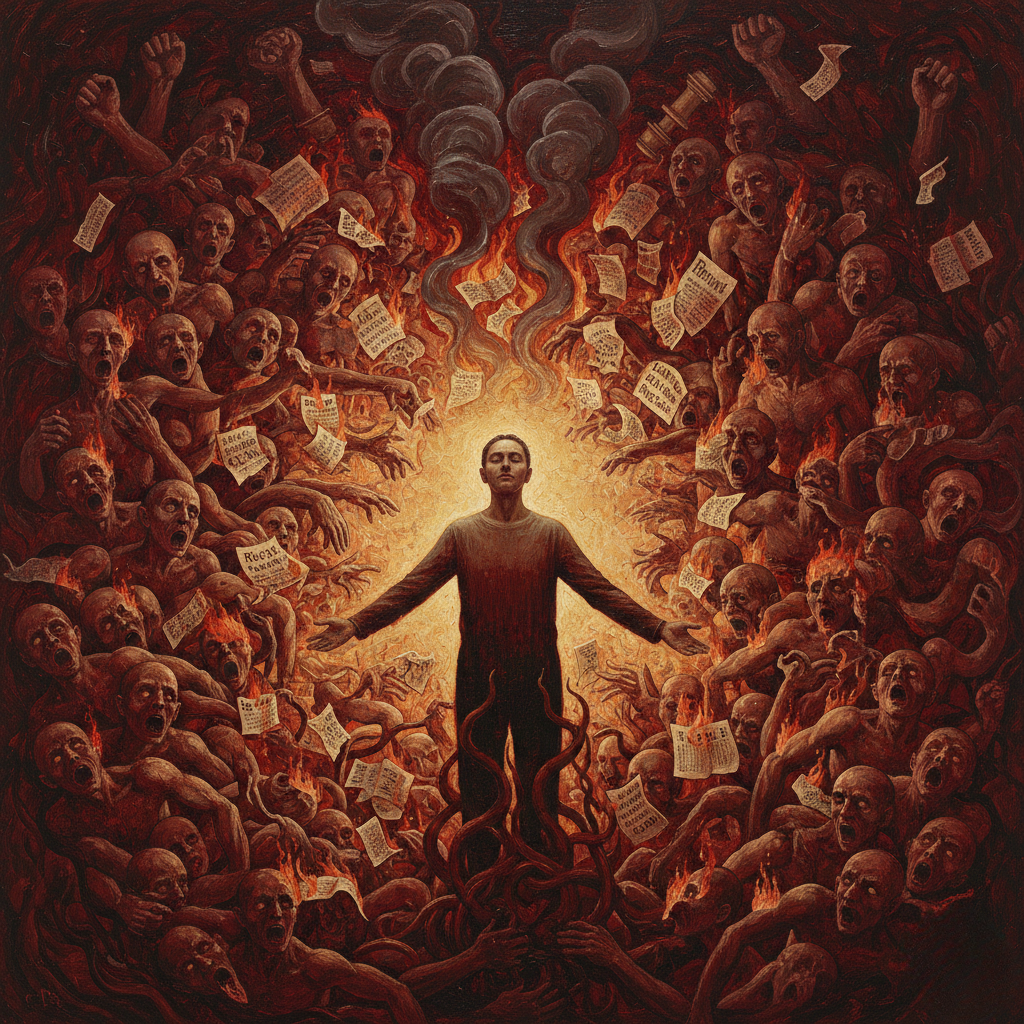
Dostoevsky’s “demons” are not supernatural beings. They are ideas. He drew his title from a scene in the Gospel of Luke where Jesus casts evil spirits out of a possessed man and into a herd of swine, which then stampede into the sea and drown. For Dostoevsky, radical ideology worked the same way: it entered people, drove them mad, and destroyed them as a group.
For the nihilists in the novel, the logic is simple: if God does not exist, everything is permitted. Murder in the service of a “future harmony” is not a crime. It is a duty.
In New Vrindaban, the ideology was different in content but identical in structure. The zonal acharya system elevated Kirtanananda to the status of “as good as God.” His commands carried the weight of divine law. When he sanctioned murder, he cited scriptures allowing the killing of “blasphemers.” One ideology said God doesn’t exist, so anything goes. The other said God speaks through me, so anything I say goes. Two doors, same room.
What Prabhupada actually taught was radically different. A genuine guru must be tested against sadhu, shastra, and guru: saintly behavior, scriptural authority, and the testimony of previous teachers. A guru who contradicts scripture is to be rejected. The zonal acharya system was not a continuation of this standard. It was its inversion. And the consequences of that inversion did not end with the RICO trials.
The Deeper Crime
One of the most disturbing elements of both stories is that the murder exists to conceal something worse.
In Demons, the revolutionary leader Stavrogin carries a secret so disturbing the censors removed it from the original publication: the rape of a child. In New Vrindaban, prosecutors argued that Bryant was killed specifically to silence his revelations about child molestation in the gurukula. There is always a deeper crime beneath the surface crime. The murder is the final act of a cover-up that began long before the trigger was pulled.
After the RICO convictions came down, Kirtanananda was imprisoned. Reformers worked to purge the worst leaders. The community convulsed and partially healed. But the underlying mechanism, the willingness to protect institutional image at the expense of actual human beings, was never dismantled.
Consider what happens when a current ISKCON guru is credibly accused of misconduct. The institutional response follows a script that Dostoevsky would recognize immediately. First, silence. The GBC receives complaints and buries them in committees. Months pass. Years pass. The guru continues initiating disciples, giving class, receiving donations. The accusers wait for a response that never comes, and eventually understand that the silence is the response.
When silence fails, because the accuser goes public, or a recording surfaces, or the evidence becomes impossible to ignore, the second mechanism activates: attack the source. The critic is labeled envious, offensive, a Vaishnava aparadhi. Their spiritual standing is questioned. Their motives are psychologized. Other devotees are warned not to associate with them. In online forums and private WhatsApp groups, the accuser’s character is dissected while the accusation itself goes unaddressed. The message to the community is clear: speaking up will cost you everything. Your friends. Your spiritual family. Your standing before God.
And when the subject is child abuse, a third mechanism appears: minimization. The abuse is reframed as something that happened “a long time ago,” as though the trauma of a molested child has an expiration date. It is described as “a few bad actors” rather than a systemic failure of institutional oversight. Leaders who protected abusers or ignored reports are not held accountable. They are quietly reassigned, or they remain in their positions and the subject is simply never raised in their presence again. The children, now adults, are offered apologies drafted by lawyers and settlements conditional on silence.
The reasoning behind all of this is always the same: we must protect Prabhupada’s movement. The institution’s reputation is treated as sacred. To expose its failures publicly is to “damage the mission.” To hold a guru accountable is to “disturb the faith of his disciples.” The calculus is always institutional survival weighed against individual suffering, and institutional survival always wins.
This is exactly the calculus that produced the murder of Steven Bryant.
The people making these decisions are not, for the most part, cynical manipulators. They are sincere devotees who genuinely believe they are serving God. And that is precisely what makes ideological possession so dangerous. The possessed person does not feel possessed. They feel righteous. They feel they are protecting something sacred. The idea that silencing a critic or ignoring an abused child could be an act of devotion makes no sense from outside the system. From inside it, it feels like the only responsible choice.
The Possessed Devotee Today
Dostoevsky saw this with perfect clarity. In Demons, the members of the revolutionary cell are not monsters at the outset. They are described as people “drawn into the world of destructive ideas through vanity, naivete, and idealism.” They are ordinary people who have surrendered their moral agency to a possessing idea. The idea tells them that the cause is more important than any individual. The idea tells them that dissent is betrayal. The idea tells them that their discomfort with what is happening is a personal weakness to be overcome, not a conscience to be listened to.
When a devotee sees evidence of guru misconduct and chooses not to speak, they are not making a free choice. They are possessed. When a temple president receives a report of child abuse and decides that “handling it internally” means handling it quietly, they are possessed. When an online mob attacks an ex-member for sharing their experience, calling them envious or demoniac, they are possessed. The demon is not a supernatural entity. It is the idea that the institution matters more than the truth.
The demons are ideas. And ideas do not die when their hosts do.